PZI Events Calendar
W E L C O M E to the PZI Events Calendar! Here you will find all upcoming events and registration links for PZI Zen Online retreats, sesshins, and weekly meditations & talks. Search by individual event, day, or month. Save to your Google Calendar or iCal Calendar. No experience required to participate. All event times are Pacific Time. Questions? Contact Lucas at PZI Support.
F E A T U R E D
April 26: What Is This Light That Everybody Has? – Deep Sit Sunday Zen with John Tarrant & Tess Beasley
May 7–10: Say A True Word & I Will Stay The Night – Open Mind Retreat with John Tarrant, Tess Beasley, & Allison Atwill
June 8–14: Dragons & Tigers, Oh My! – Our Great Summer Sesshin with John Tarrant & PZI Teachers

- This event has passed.
TUESDAY ZEN with David Weinstein: Equanimity #2: Vast Emptiness, Nothing Holy
REGISTER
Emperor Wu asked the great teacher Bodhidharma,
“What is the first principle of the holy teaching?”
Bodhidharma said, “Vast emptiness, nothing holy.”
“Who are you, standing here in front of me?” asked the Emperor.
“I don’t know,” said Bodhidharma.
The Emperor didn’t understand.
Bodhidharma crossed the river and went into the Kingdom of Wei.
—Blue Cliff Record Case 1, & Book of Serenity Case 2 (translation by John Tarrant & Joan Sutherland)
As I have been sitting with this snippet of the longer story of the meeting between Bodhidharma and Emperor Wu, I am reminded that the Emperor’s question about the first principle came after he had asked Bodhidharma about the merit he had gained from all of the good works he had done in promoting the teachings. Bodhidharma’s response was, “No merit whatsoever.” That puts the question about the first principle into a different context for me.
I imagine Emperor Wu to have been taken aback by Bodhidharma’s response. Asking about the first principle feels like the Emperor’s first salvo in defending himself from, and arguing against, Bodhidharma’s assessment. I imagine the emperor thought the first principle would have supported doing good works as he had done. But Bodhidharma was bringing a different kind of practice with him than what had been familiar to the Emperor. Bodhidharma’s practice was the practice of Prajna Paramita, the practice of his teacher Prajnatara. The teaching of vast emptiness and nothing holy. When the Emperor confronts Bodhidharma by asking him, “Who are you, standing here in front of me?” I hear him saying, “Who are you to speak to me that way after all I have done for the teaching?”
As for Bodhidharma’s response of, “I don’t know” I think he was being genuine. Not in the sense of quoting doctrine, but rather truly questioning himself. I imagine that prior to asking about the merit he had accumulated, the Emperor detailed exactly what all those good works were. How could he not offer doing some good works specifically for Bodhidharma himself, or at least imply that he was open to doing so. That would certainly be a feather in the Emperor’s cap. I further imagine that Bodhidharma may very well have been tempted by the Emperor’s offer, which may have shocked him and led him to question just how well he knew himself.
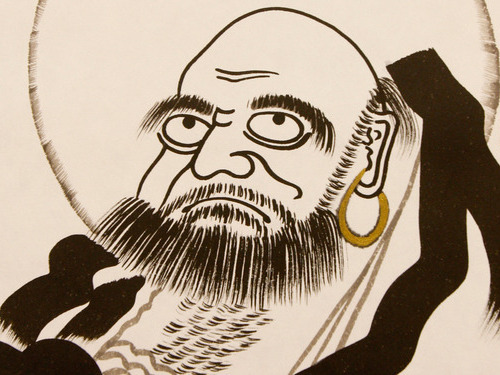
We are told that after this encounter with the Emperor, Bodhidharma went and faced a wall for either seven or nine years, depending on the version of the story. We’re also told that while facing the wall meditating, after having dozed off during his meditation, he cut off his eyelids, giving him that signature glare. I think if he truly knew who he was and truly didn’t know who he was, he wouldn’t have done that.
But that’s just my dream of this koan, what’s yours?
—David Weinstein

COME JOIN US on Tuesdays for koan meditation, dharma talk and conversation.
Register to participate. All are welcome.
David Weinstein Roshi, Director of Rockridge Meditation Community