PZI Events Calendar
W E L C O M E to the PZI Events Calendar! Here you will find all upcoming events and registration links for PZI Zen Online retreats, sesshins, and weekly meditations & talks. Search by individual event, day, or month. Save to your Google Calendar or iCal Calendar. No experience required to participate. All event times are Pacific Time. Questions? Contact Lucas at PZI Support.

F E A T U R E D
April 26: What Is This Light That Everybody Has? – Deep Sit Sunday Zen with John Tarrant & Tess Beasley
May 7–10: Say A True Word & I Will Stay The Night – Open Mind Retreat with John Tarrant, Tess Beasley, & Allison Atwill
June 8–14: Dragons & Tigers, Oh My! – Our Great Summer Sesshin with John Tarrant & PZI Teachers

- This event has passed.
MONDAY ZEN with Jon Joseph: Zen and the Ways: Searching for a Master Swordsman
REGISTER
For thirty years I searched for a master swordsman.
How many times did the leaves fall
and the branches break into bud?
But from the moment I saw the peach blossoms, I’ve had no doubts.
—Entangling Vines, Case 8
The above poem was written by the 9th century Chan-Zen master Lingyun Zhiqin, on his becoming awakened while turning a corner in the road and seeing across the valley peach trees in bloom. What did he realize? For a moment he dropped his search for mastery and realized the intimate, personal beauty of the blossoms.
Some five centuries later, the Japanese priest Keizan Jokin wrote:
The village peach blossoms didn’t know
their own pink
but still they freed Lingyun
from all his doubts.
Our search for a master swordsman in Chan-Zen is not so different from the search for mastery in the traditional East Asian arts of self-defense. Both seek to drop the self and find the Way.
“Archery, therefore, is not practiced solely for hitting the target,” writes Eugen Herrigel, in his classic Zen in the Art of Archery (1953), “The mind must be attuned to the Unconscious. If one really wishes to be master of an art, technical knowledge is not enough. One has to transcend technique so that the art becomes an ‘artless art’ growing out of the Unconscious.” The master swordsman must forget the sword.
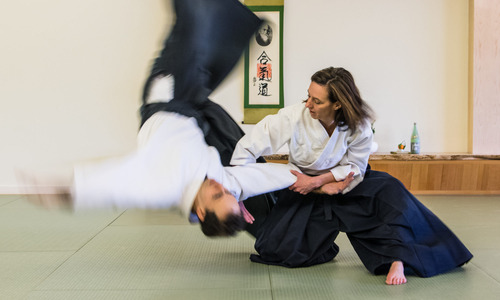
There is probably no martial art more closely associated with Zen Buddhism in recent years than Aikido (合気道), sometimes translated as “The Way of the Harmonious Spirit.” Developed by Morihei Ueshiba (honorifically called, “Osensei”) in the 1920s to defend oneself against an attacker without seriously injuring the assailant, the defender actually uses the momentum of the attack against the attacker himself.
“It’s a lot like dancing,” says Lance Sobel, who has just returned from a three-day Aikido training period. Lance, a fourth-degree black belt, has been practicing Aikido for fifty years and Zen meditation for nearly as long. He got into martial arts in his early 30s, and decided to try something other than Karate after breaking bones in both hands after a training session. He notes that early training in Aikido is structured: one partner attacks, the other partner moves out of range and as the attacker comes closer, immobilizes or throws them across the mat. More advanced training is spontaneous and free-form: the defender looks for openings with energy, redirects that energy, the two enter that dance.
“When the dance starts happening in a dynamic way, there is an incredible sense of the universe, of expanded awareness,” says Lance. “Where can I safely move? Where can I move them? You are not locked into a predetermined response; it moves more like an organism.”
Todd Geist, a Head of Practice at Pacific Zen and a second degree Aikido black belt writes, “What I loved most about Aikido training was the sense of absolute ease that could come even when being tossed head over heels across the mat. There would be this moment of contact with your partner, and your body just reacts. Suddenly you are in the air. Not because your partner overwhelmed or hurt you, but because that was the best way to resolve the situation and dissipate the energy of conflict, and your body just knew how to do it. It wasn’t always, or even often like that, but when it was, I felt completely free.”
“We are doing Aikido in order to become freer ultimately,” writes Seishiro Endo, 8th dan and elder in the original Aikikai school. “We must savor the circumstance at this moment now as it vibrates from the partner, open our senses regarding the whole situation around us, and be able to give rise to function. I hope that we will continue to practice while valuing the vibration in this moment, now, now, now…”
—Jon Joseph

COME JOIN US on Mondays for koan meditation, dharma talk and conversation. Register to participate. All are welcome.
Jon Joseph Roshi, Director of San Mateo Zen Community