PZI Events Calendar
W E L C O M E to the PZI Events Calendar! Here you will find all upcoming events and registration links for PZI Zen Online retreats, sesshins, and weekly meditations & talks. Search by individual event, day, or month. Save to your Google Calendar or iCal Calendar. No experience required to participate. All event times are Pacific Time. Questions? Contact Lucas at PZI Support.

F E A T U R E D
April 26: What Is This Light That Everybody Has? – Deep Sit Sunday Zen with John Tarrant & Tess Beasley
May 7–10: Say A True Word & I Will Stay The Night – Open Mind Retreat with John Tarrant, Tess Beasley, & Allison Atwill
June 8–14: Dragons & Tigers, Oh My! – Our Great Summer Sesshin with John Tarrant & PZI Teachers

- This event has passed.
MONDAY ZEN with Jon Joseph & Friends: It’s Hard Being a Human
REGISTER
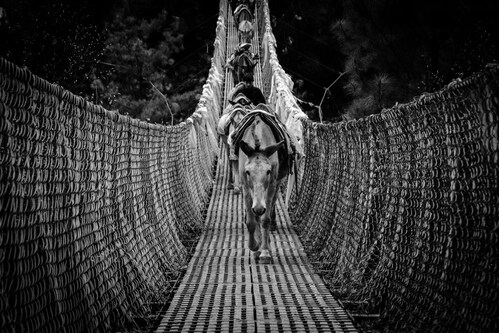
A student asked Zhaozhou, “For a long time I’ve heard about the stone bridge of Zhaozhou. But now that I’ve come, I see only a log across the river.”
Zhaozhou said, “You only see the log, you just don’t see the stone bridge.”
“What is the stone bridge like?”
“It helps donkeys cross over, horses cross over.”
I recently came across Koun Yamada’s commentary on this case:
The essential world is not one thing. Just as a perfectly white movie screen is covered with various images as the film progresses, the bridge lets donkeys and horses cross. The bridge corresponds to the movie screen. Although the screen is still white, in the essential world, which is the stone bridge, even the color is gone. It is across the bridge of emptiness that horses and donkeys pass.
Since the early months of my practice, this metaphor has made a deep impression on me. We need the empty screen of the universe as a kind of bridge and the screen needs the content of our movie—the horses and donkeys of our lives—to be fulfilled. How we appear and pass over together is a mystery.
Once a year, I sign onto the intoxicating glamour, creativity and beauty of the Oscars. It was especially fun this year because a friend had a small role in a film up for Best Picture, an adventure he detailed a few months ago in a newspaper article. They shot some of his scenes in Japan, which he calls home. Often self-effacing, he mentioned to me that he took the role mostly to support his family, but also for him, he said, it was a leap into the unknown. Horses cross over.
In the early 1980s, I too got an invitation to appear in a Japanese movie. Through an acquaintance, I met Yumiko, an ekisutra actress. She needed a “foreigner boyfriend” to partner with, so we agreed to meet on the set in a couple of weeks. The movie series Otoko wa Tsurai Yo (It’s Hard To Be a Man), popularly known as Tora-san (Mr. Tiger), is named after the n’er-do-well street merchant who always falls in love with a leading lady of the time, then bolts just before the consummate their friendship. It was a hugely popular genre series that appealed to the Japanese working class: Tora-san was the antithesis of the new Japanese salaryman, who increasingly felt regimented by the country’s economic miracle and estranged from traditional home and family. The series ran twice annually for 26 years and became one of the iconic franchises in Japanese film history.
We got to the film location, a Western restaurant outside of Kamakura, and briefly met Yoji Yamada, the writer and director. We were soon handed us off to an assistant director and I got a backpack and baseball cap to wear. Tora-san and his sister’s family were having lunch. As extras, our role was to walk by the family’s table, bump into the kid star, and quickly exit the restaurant to be seen in an action background through a picture window as the family continued to talk. On the second take, I jostled the boy and said “Sumimasen! (excuse me)”, which turned out to be the one speaking role of my movie career. Uncredited. Later, the director called me a “natural.” Donkeys cross over too.
Yamada had known Yumiko since she was a child; her father was a well-known novelist and she grew up hanging out on the Shochiku lot picking up occasional bit parts. On the lot, she met a young man and they decided to go to Hollywood to break into American movies. Unsuccessful, they left the city and moved to the mountains of California. While there, her young husband got sick, was rushed to the hospital, but succumbed to his illness. The doctors later diagnosed bubonic plague, which rats first carried to California on a steamship from Asia at the turn of the last century. Though rare, the plague continues to live in the ground squirrel population in the Western U.S.
Utterly devastated, Yumiko returned to Japan, and Tora-san’s Yamada read about her tragic story in the newspaper. He called her up: “I want you to be in my next film,” he said, “But you need to find a foreigner as your boyfriend.” It is wonderful when we can cross over together.
—Jon Joseph

COME JOIN US on Mondays for koan meditation, dharma talk and conversation. Register to participate. All are welcome.
Jon Joseph Roshi, Director of San Mateo Zen Community